Want to help translate WFB-X into your own language? There are two separate pieces you can contribute -- either one on its own is useful, you don't need to do both.
1. Catalog (Rules, Gear, Lores, Spells)
Short entries -- translate each one's description text. The easier, lower-risk of the two.
The full rulebook chapters as raw HTML. Only translate the readable text --
every HTML tag and attribute must stay exactly as it is, or the page will render wrong.
Bigger and more involved than the Catalog above.
Each file already includes instructions for whoever (or whatever AI) does the translating.
A human reviews every submission before it goes live -- uploading doesn't publish automatically.
Account
Forming Units
Models are organised into units -- usually several banded together,
though a single powerful model (a character, a chariot, a Dragon, or a war
machine and its crew) also counts as its own unit.
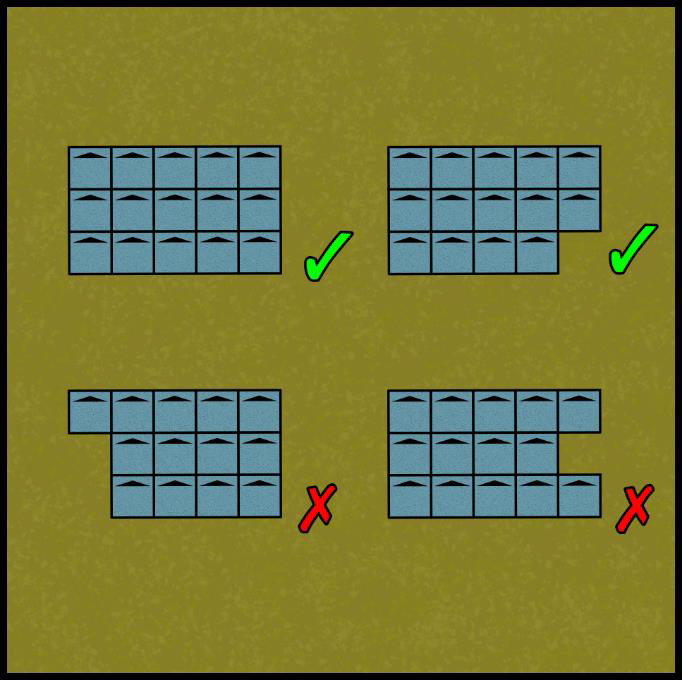
A unit is arranged in base contact, in horizontal ranks and vertical
files, with every model facing the same direction. A unit can't have more
ranks than files, except temporarily to squeeze through a gap too narrow to
pass otherwise -- it must return to a legal formation again as soon as
possible afterward. Models are spread as evenly as possible across ranks,
with any shortfall left in the rearmost rank, kept centred.
A model is never considered to be in base contact with itself, only with
other models.
Here you can see examples of correct and incorrect formations.
WFB-X is a private, non-commercial hobby project -- maintained by a single fan and their
local gaming group to keep playing the version of Warhammer Fantasy Battles they grew up
with, not run as a business or by any company or studio. Nothing on this site is sold, and
it exists purely to keep a beloved game playable for the small community that still plays
it. It continues Mathias' own 9.x rules (his February 2022 release,
warhammerarmiesproject.blogspot.com).
This site is not produced, endorsed, sponsored, or approved by Games Workshop Limited, and
no Games Workshop trademarks, logos, or copyrighted artwork are used here. Warhammer
Fantasy Battles and all associated names, races, and imagery are the property of Games
Workshop Limited.
Thank You
The little icons scattered through the forum aren't ours -- they're borrowed, with real
gratitude, from talented artists on
game-icons.net, released
under CC BY 3.0.
Free work, freely shared -- it adds a bit of personality here that plain text never could.